At 37 years old and with three children at home, Ashli Anderson never expected to find herself preparing her family for a future without her.
But after being diagnosed with a meningioma in September 2025, fear of what might happen began to take over.
“I was living in anxiety, fear, preparing for the end of my life,” Ashli says.
The months that followed would bring brain surgery, uncertainty and ultimately good news—but also a new perspective on how Ashli wants to spend her life.
A Tumor That May Have Been There for Years
Ashli’s surgeon believes her meningioma had likely been growing slowly for at least five or six years, and possibly longer.
After her diagnosis, he reviewed a CT scan Ashli had undergone following a car accident in December 2021. Although the tumor had not been identified at the time, her surgeon could see what appeared to be evidence of it on the earlier scan.
Suddenly, Ashli was facing brain surgery.
Her operation was scheduled for December 30, 2025. During the months between her diagnosis and surgery, Ashli found herself confronting possibilities she had never imagined.
“I didn’t know if I would come out of the surgery or if I would die after because of a complication,” she says.
Ashli is the mother of three boys—a teenager and two children under the age of five. Faced with that uncertainty, she began preparing for the possibility that she might not be there as they grew up.
She wrote letters for her children to open on special dates throughout their lives. She wrote letters to her husband, parents, family members and friends. She prepared a will, trust and medical directives.
“I was preparing not to live through it,” she says.
Good News After Surgery
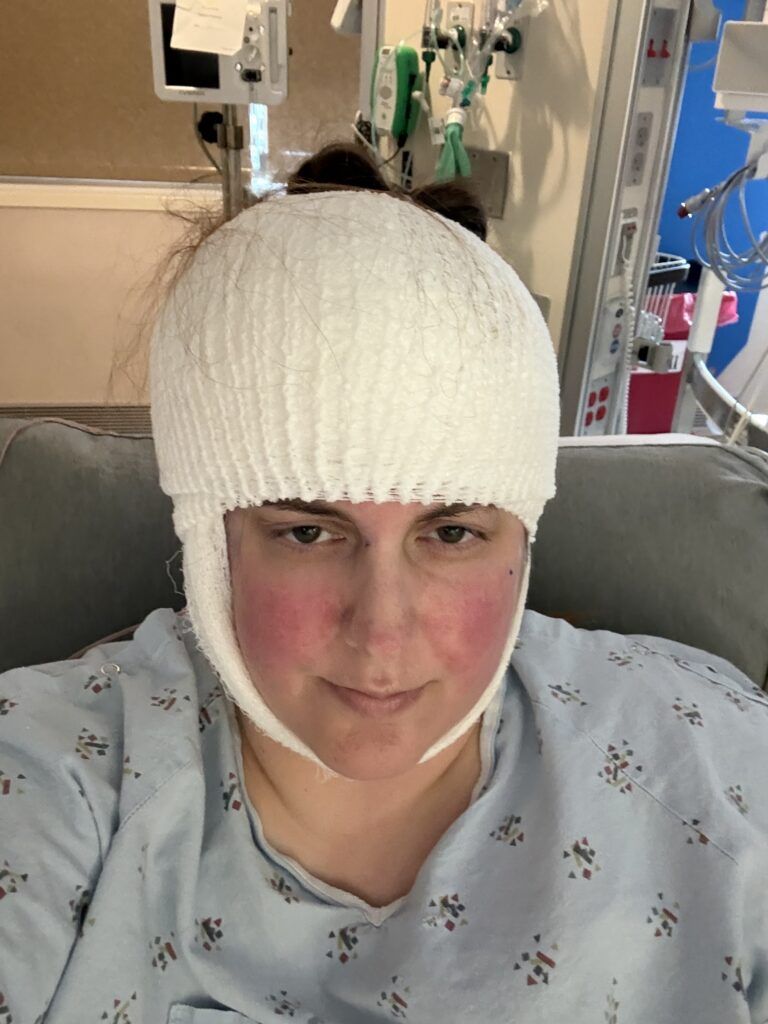
Ashli underwent surgery on December 30. Afterward, she learned that her tumor was a Grade 1 meningioma.
She would not need radiation or chemotherapy.
“I am blessed to be alive,” Ashli says.
But recovery has also taught her that getting through brain tumor surgery doesn’t necessarily mean the journey is over.
Just four weeks after surgery, Ashli was still experiencing a number of symptoms, including increased problems with short-term memory, numbness and tingling in her hands, jaw pain near her incision and blurry vision in her right eye.
Her symptoms have also affected her ability to work. For now, she is working only a few hours each day while she continues to recover and waits for follow-up imaging.
There are still questions about what will improve with time and what might become part of her new normal.
Looking at Life Differently
Despite those uncertainties, Ashli says she is trying to stay positive and lean on her faith.
“He got me through surgery. He gave me more time with my family and friends,” she says. “That is all I can ask for.”
She is also beginning to think differently about what recovery—and the future—might look like.
Before her diagnosis, Ashli says she worked too much. Financial responsibilities meant returning to work earlier than she would have liked after having her children.
Now, even the possibility that she might not return to full-time work has taken on a different meaning.
“Honestly, maybe that is a blessing,” she says. “Then I get to spend more time with my family.”
For Ashli, surviving a brain tumor has become an opportunity to reconsider what deserves her time and attention.
“Maybe now is my chance to live life, focus on me, focus on my family and just living.”
Adjusting to Life After Brain Tumor Surgery
Recovery after brain tumor surgery can look different for every person. Physical, cognitive and emotional changes may continue after leaving the hospital, and adjusting to those changes can take time.
The American Brain Tumor Association provides trusted information and personalized support for patients and families at every stage of the brain tumor journey—from diagnosis and treatment through recovery and survivorship.
For information and support, connect with the ABTA CareLine at 800-886-ABTA (2282) or explore resources at abta.org.